Leaky, Sagging Attic Ducts: What Sealing and Repair Fix
Attic ducts take more abuse than any other part of the system, and the fixes are more mechanical than most people expect.
October 27, 2026 · 4 min read
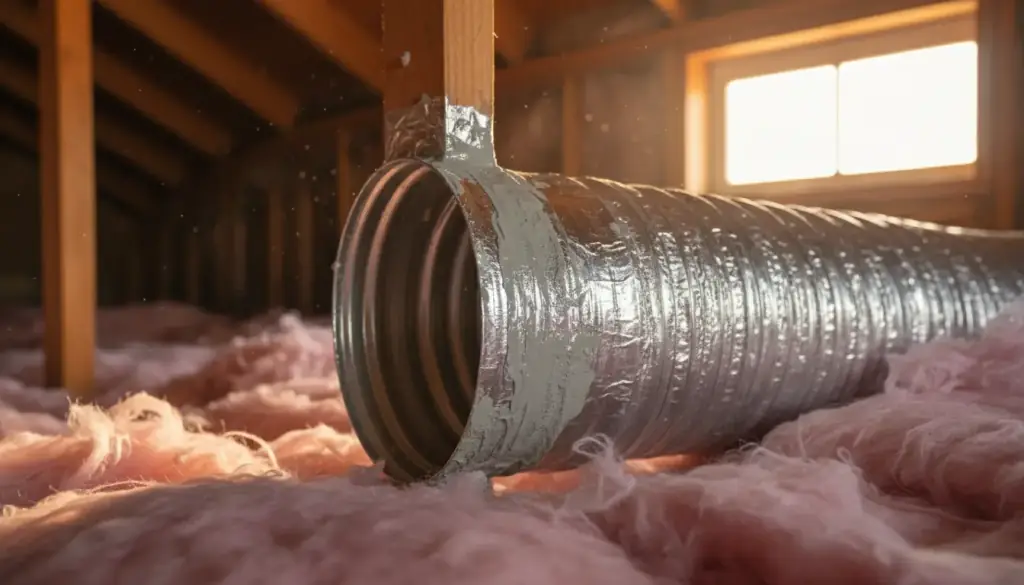
Open the attic hatch on a Houston summer afternoon and you're looking at one of the harshest places in the house to run a duct. Plenty of homes have their ductwork up there anyway, and attic ducts take abuse that ducts inside the conditioned space never see. When someone says an upstairs room never cools, the attic ducts are a good place to start looking.
What the attic does to a duct
Flexible duct is a wire coil wrapped in a thin plastic liner, a layer of insulation and an outer jacket. It's inexpensive, it bends around obstacles and it's quick to install, which is why it's everywhere. It also sits in heat that can soften the jacket and dry out tape, and in humid air that sweats on any cold surface. Over the years those conditions loosen connections, tear jackets and let insulation settle.
How leaks happen
Most air loss comes from joints. A connection where a branch meets the trunk, or where a duct meets a register boot, is held by a strap and sealed with tape or mastic. Cloth-backed duct tape, the grey roll most people picture, doesn't make a lasting seal. In a hot attic its adhesive dries out and the tape lets go. Once a joint opens, conditioned air spills into the attic instead of the room, and on the return side, attic air gets pulled in.
Leaks carry dust, too. Pulled-in attic air brings insulation fibers and grit into the system, which is why a leak and a dirty duct so often show up together. Cleaning a leaky duct without sealing it invites the same dust right back.
Sagging, kinks and crushed runs
Flex duct needs support at regular intervals so it stays round and fairly straight. When a hanger breaks, or a duct was never supported properly, it sags. A sag narrows the passage, and a hard bend, called a kink, narrows it more. The blower pushes against that resistance, so the rooms at the end of the run get less air. Debris pools in the low point of a sag, and moisture can collect there as well. A duct that's been stepped on, or crushed under stored boxes, causes the same trouble.
Insulation and sweating
Cold air moving through a duct chills the surface, and a cold surface in humid attic air collects water, the way a glass of iced tea does on a porch. Good insulation and an intact outer jacket keep the surface warm enough to stay dry. Where the insulation is torn, thin or soaked, water can drip onto the ceiling below and leave a brown stain, or feed mold in the insulation itself. Wet insulation doesn't insulate, so the problem keeps feeding itself.
What sealing and insulation repair involve
The work is mostly hands-on and mechanical. Typical repairs include:
- Mastic or foil tape on the joints, with a clamp or strap holding the connection, instead of cloth tape alone.
- Re-hanging sagging runs with proper straps or saddles, and straightening kinks.
- Replacing sections of duct whose liner or jacket is torn or whose insulation is soaked.
- Adding or re-wrapping insulation where a run is bare.
- Reconnecting any branch that has pulled loose from the trunk or a register boot.
Houston Air Duct Cleaning lists duct insulation and sealing, and ductwork installation and repair, among its services, next to duct cleaning. Which repairs a given house needs depends on what the estimate turns up. Ask whether sealing happens before or after the cleaning on your visit, since fixing the leaks keeps freshly cleaned ducts from filling with attic dust again.
Signs worth checking
A room that never catches up with the thermostat is the classic one. A hot, musty smell when the system starts is another. So are brown ceiling stains under the attic ducts, dust that comes back days after you've wiped the vents, and a system that seems to run all the time. None of these proves a leak by itself, but together they point toward the attic.
You can also look at the registers. If one blows noticeably weaker than the others on the same system, that run is a candidate for a kink, a disconnect or a crushed section. Write down which room it is. That detail saves time when someone goes up to look.
Stay out of the attic during Houston's hot months unless you have to go up. It gets dangerously hot, and the framing is easy to step through. A technician can do the looking, and the estimate costs nothing. Houston Air Duct Cleaning offers a free one, and you can reach it at (281) 715-0597, open every day from 8 AM to 11 PM.
Houston Air Duct Cleaning, (281) 715-0597
Call (281) 715-0597More articles
What Collects Inside a Houston Home's Ducts, Stop by Stop
Dust doesn't settle evenly in a duct system, and knowing where each kind lands explains what a real cleaning has to reach.
Mold in Air Ducts: Where It Grows and What Removal Involves
Mold in ductwork needs moisture, dust and time, and Houston's humidity supplies the first of those for most of the year.